
ADM Construction & Lighting Articles
Explore technical insights, architectural lighting trends, and engineering solutions from Egypt's trusted building materials specialist.
How to Choose Facade Lighting Solutions for Global Projects
Table of Contents
- Define Project Goals and Facade Lighting Requirements
- Assess Building Architecture, Site Conditions, and Climate
- Select Suitable Lighting Technologies and Fixture Types
- Plan Energy Use, Controls, Maintenance, and Compliance
- Evaluate Suppliers, Costs, Installation, and Long-Term Performance
- FAQS
- Conclusion
- Related Posts
Choosing Facade Lighting Solutions for global projects requires more than selecting bright fixtures or attractive effects. It requires evidence, local experience, and respect for the building’s purpose. The International Energy Agency reports that buildings consume about 30% of global energy and produce approximately 26% of energy-related emissions. The 2023 UNEP Global Status Report adds that buildings accounted for around 34% of global energy demand in 2022. These figures make efficiency a design responsibility, not a marketing claim.
Rogier van der Heide, an internationally recognized architectural lighting designer, has said, “Light is not a thing, it is an experience.” His observation changes the decision process. A successful facade should reveal texture, entrances, rhythm, and public movement without overpowering nearby homes or night skies. Specify efficient LEDs, precise optics, dimming controls, and maintenance access. Test samples on the actual facade. A white stone surface can appear cold under one beam and warm under another.
Global projects also demand local judgment. Climate, dust, humidity, cultural expectations, heritage rules, and municipal limits can change the correct solution. The U.S. Department of Energy highlights controls and reduced lighting power as important strategies for building energy performance. Still, reports cannot predict every street condition. No checklist is flawless. A pilot installation may expose glare, uneven brightness, or an unsuitable color temperature before full procurement. That small failure can prevent a costly one. Choose Facade Lighting Solutions that remain measurable, repairable, and visually calm after opening night.
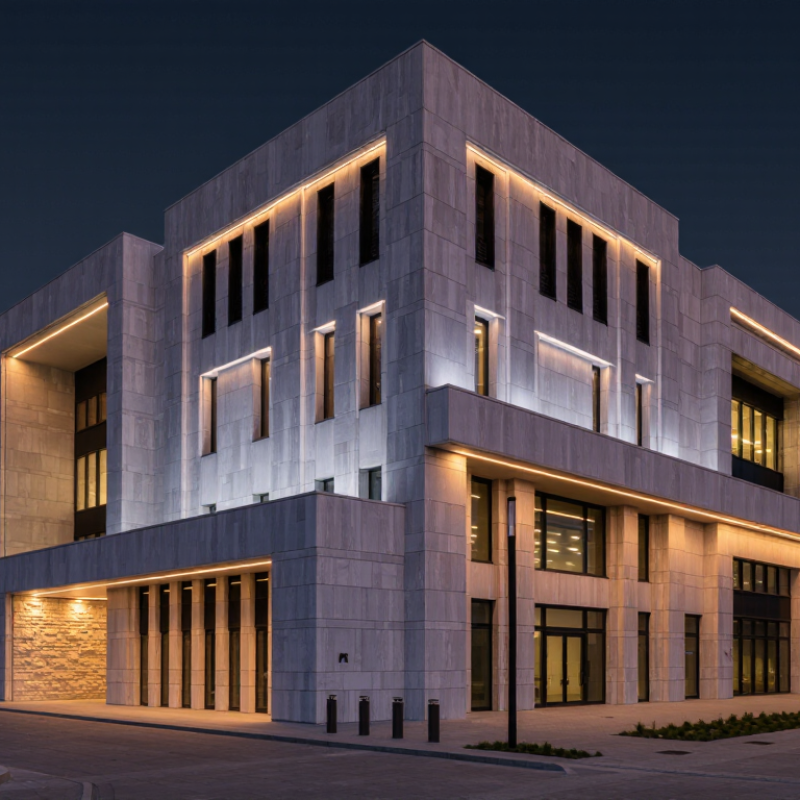
Define Project Goals and Facade Lighting Requirements
How to Choose Facade Lighting Solutions for Global Projects
Define the project’s purpose before selecting fixtures. Is the facade guiding visitors, strengthening civic identity, or supporting retail visibility? The answer changes brightness, color, timing, and viewing distance.
A museum may need calm, low-contrast illumination. A transport hub needs clearer edges and stronger wayfinding.
The International Energy Agency reports that lighting uses about 15% of global electricity.
Therefore, decorative ambition must be tested against operating hours and energy targets.
Start with a site survey. Record facade materials, nearby residences, road angles, tree cover, and existing glare sources.
Then set measurable requirements for illuminance, luminance, uniformity, color temperature, beam control, ingress protection, and maintenance access.
CIE 150:2017 provides guidance for limiting obtrusive light, including glare and light spill. Local planning rules still control the final design. They can differ sharply between cities.
Never assume one global standard is enough.
Build a night-time mock-up before approval. Compare stone, glass, metal, and textured concrete under real weather conditions.
Use calibrated photometric calculations, but inspect the result from sidewalks and upper-floor windows.
Software can miss discomfort caused by a single exposed optic. That detail matters.
The IEA also links efficient lighting with controls, not only efficient sources. Dimming schedules, presence detection, and seasonal scenes can reduce wasted energy.
I have seen projects over-light dark facades because brighter images looked impressive. That decision often weakens visual hierarchy and increases complaints.
Reconsider the first concept.
Assess Building Architecture, Site Conditions, and Climate
Facade lighting should begin with the building, not the fixture schedule. Study façade depth, material reflectance, window rhythm, balconies, and maintenance access. A pale stone wall may need less output than dark brick. Glass can create unexpected reflections for drivers and residents. In practice, a perfect rendering can still hide harsh glare.
Site conditions change the specification. Survey nearby roads, trees, signage, residences, and protected habitats during both daylight and darkness. CIE 150:2017 provides guidance for limiting obtrusive light. Measure wind exposure, salt spray, dust, drainage, and mounting vibration. Coastal façades may require stronger corrosion protection, while dusty sites demand easier cleaning. IP ratings help, but they do not replace a real maintenance plan.
Climate must shape controls and operating hours. The WMO State of the Global Climate 2023 reported a global mean temperature about 1.45°C above the pre-industrial average. The UNEP Global Status Report for Buildings and Construction 2023 found that buildings used 34% of global energy and produced 37% of energy and process-related carbon emissions in 2022. Dimming, occupancy response, and seasonal schedules therefore matter. Avoid over-lighting the façade. That decision is often harder than adding brightness. A useful design may still need revision after the first night survey.
Select Suitable Lighting Technologies and Fixture Types
How to Choose Facade Lighting Solutions for Global Projects
Select Suitable Lighting Technologies and Fixture Types
Facade lighting should begin with the building’s materials, geometry, and surrounding environment. LED systems usually provide efficient output, long service life, and precise control. However, efficiency alone does not guarantee a successful result. A cool white source can make stone appear grey, while excessive brightness may disturb nearby residents or drivers. Review color temperature, color rendering, beam angles, glare control, and dimming performance together. Photometric simulations are valuable, but an on-site mock-up often reveals details that drawings miss. I have seen attractive concepts fail because light spilled onto windows or highlighted surface defects.
Choose fixture types according to the facade’s visual structure. Linear grazers suit textured walls and narrow architectural edges. Wall washers create broader, more even coverage on smooth surfaces. Compact projectors work well for columns, signs, and distant focal points. In-ground fixtures can emphasize entrances, but drainage and service access require careful planning. Specify suitable ingress protection, impact resistance, corrosion protection, and operating temperatures for each climate. Coastal projects need stronger material protection. Cold regions may require tested drivers and flexible installation methods. Local electrical rules and maintenance skills must guide the final selection.
Tips: Test several beam angles before approval. Keep spare components accessible. Avoid lighting every surface equally. Consider nighttime neighbors, energy limits, cleaning schedules, and future replacement. A render may look perfect, yet real facades are rarely perfect. Build in adjustment.
Plan Energy Use, Controls, Maintenance, and Compliance
How to Choose Facade Lighting Solutions for Global Projects
Facade lighting should begin with an energy model, not a fixture catalogue. Estimate operating hours, seasonal darkness, local tariffs, and required brightness. Use efficient optics to place light on the facade, rather than nearby windows or roads. A site drawing should show shadows, glare risks, mounting heights, and access routes. Measure real night conditions where possible. Renderings can mislead.
Controls determine whether efficiency survives daily operation. Combine astronomical clocks, dimming schedules, occupancy inputs, and remote fault alerts. Set different scenes for normal nights, events, cleaning, and emergency access. Keep manual override available, but log every change. Commission the system after installation, then check it during wet and cold conditions. Small errors matter. A timer set to the wrong time zone can waste energy for months. Field reviews often show control logic becoming too complicated for local teams. Simpler programming is usually safer.
Maintenance planning should identify lamp access, cleaning intervals, spare components, and safe isolation procedures. Choose corrosion-resistant equipment for coastal air, dust, or heavy rain. Document illumination levels, electrical testing, environmental limits, and disposal requirements for each jurisdiction. Confirm planning permissions, heritage restrictions, light-spill limits, and worker-safety rules before procurement. Independent testing can reveal overheating, glare, or uneven color. Compliance is not a paperwork exercise. Yet project teams sometimes treat it that way. Leave clear records, because future technicians may not know why each setting was chosen.
Evaluate Suppliers, Costs, Installation, and Long-Term Performance
Choosing facade lighting for a global project requires more than comparing fixture prices. The 2023 UNEP Global Status Report states that buildings consume about 30% of global final energy. Efficient facade systems can reduce operating pressure, especially when dimming responds to occupancy, daylight, or event schedules. However, efficiency claims need proof. Request LM-79 photometric reports, LM-80 lumen-maintenance data, thermal test results, and regional compliance documents. Supplier transparency matters more than polished catalogues.
Evaluate total cost across the project lifecycle. Include luminaires, control hardware, wiring, lifting equipment, commissioning, maintenance access, and replacement stock. A cheaper fixture may require frequent access to a 20-storey facade. That saving can disappear quickly. The U.S. Department of Energy’s 2023 Solid-State Lighting R&D report highlights thermal management and controllability as continuing performance priorities. Ask suppliers for verified lifetime data at the actual ambient temperature, not only laboratory conditions. A small on-site mock-up can expose glare, uneven spacing, weak color consistency, and difficult cable routes. Do not skip it.
Tips: Score suppliers against identical criteria. Check references in similar climates. Confirm spare-part availability for at least ten years. Specify corrosion resistance near coastlines. During installation, photograph cable glands, aiming angles, and drainage details. Commission scenes after dark, then measure illuminance at pedestrian level. Plans are never perfect. Field conditions often prove otherwise. Recheck assumptions before approving the final handover.
FAQS
Study the facade materials, geometry, nearby buildings, roads, and residents. Stone may look grey under cool white light. Start with a mock-up.
LED systems offer efficient output, long service life, and precise control. Efficiency alone is not enough. Control quality matters.
Linear grazers suit textured walls and narrow edges. Wall washers cover smooth surfaces evenly. Compact projectors highlight columns and distant details.
Review color temperature, color rendering, beam angle, glare, dimming, and operating temperature. Also check ingress and impact protection.
Drawings may hide glare, uneven spacing, surface defects, or awkward cable routes. Test several beam angles after dark. Real walls often disagree.
Use identical scoring criteria for every supplier. Request photometric, thermal, lifetime, and compliance documents. Catalogues can look better than reality.
Include fixtures, controls, wiring, lifting equipment, commissioning, maintenance access, and spare components. A low purchase price may become expensive later.
Coastal projects need stronger corrosion protection. Cold regions need tested drivers and flexible installation methods. Local skills and electrical rules also matter.
Use dimming based on schedules, daylight, occupancy, or approved events. Avoid lighting every surface equally. Measure pedestrian-level illuminance after commissioning.
Keep spare components accessible for future replacement. Confirm long-term availability. Photograph cable glands, aiming angles, and drainage details during installation. Recheck assumptions.
Conclusion
Choosing Facade Lighting Solutions for global projects begins with clearly defining the project’s purpose, visual identity, performance goals, and lighting requirements. Designers should assess the building’s architecture, surrounding environment, installation conditions, and local climate to ensure that the proposed system is durable, visually balanced, and suitable for long-term outdoor use. The selection of lighting technologies and fixture types should consider beam angles, color quality, brightness, weather resistance, energy efficiency, and compatibility with the facade materials.
A successful plan also includes energy management, intelligent controls, maintenance access, safety standards, and regional compliance requirements. Before making a final decision, project teams should evaluate suppliers based on technical expertise, product reliability, communication, installation support, total cost, and expected service life. Considering operating expenses, replacement needs, and future adaptability helps ensure that the lighting system delivers consistent architectural impact while remaining practical, efficient, and sustainable across different global locations.

Blog Tags: