Modern industrial facility sourcing has moved beyond basic lumen-per-watt metrics. Today's global procurement standards mandate comprehensive thermal dissipation analysis, TM-21 lumen maintenance projections (L90/B10 > 100,000 hours), driver failure rate metrics (<0.2% per 1,000 hours), and high-vibration structural integrity (IK10 ratings). Selecting the optimal industrial lighting fixtures directly impacts plant safety, energy compliance (ISO 50001), and operational downtime.
1. Product Specifications & Technical Breakdown of Industrial Lighting Fixtures
Industrial lighting environments—ranging from heavy manufacturing plants, automated logistics hubs, chemical processing units, to high-vibration power generation facilities—require specialized luminaire architectures. Standard commercial lighting fails rapidly under industrial thermal stresses, voltage fluctuations, and particulate exposure.
A. Heavy-Duty LED High-Bay Luminaires (UFO & Modular Form Factors)
Designed for installation heights spanning 6 meters to over 25 meters, heavy-duty LED high-bays form the backbone of industrial infrastructure lighting. The structural engineering of these fixtures relies on high-purity die-cast ADC12 copper-free aluminum heatsinks optimized via Computational Fluid Dynamics (CFD) thermal modeling.
- Thermal Dissipation: Integrated pin-fin or continuous chimney heat sinks maintaining junction temperature ($T_j$) below 75°C under ambient operating temperatures of +55°C to +65°C.
- Optical Precision: Precision-molded PMMA or tempered glass lenses offering symmetric beam distributions ($60^\circ, 90^\circ, 120^\circ$) and asymmetric aisle optics to reduce Unified Glare Rating (UGR < 19) in narrow rack warehouse environments.
- Electrical Reliability: Premium Class I/II drivers with integrated 10kV/20kV surge protection devices (SPD) capable of withstanding industrial grid transients and THD < 8%.
B. Hazardous Location & Explosion-Proof Fixtures (Class I Div 1/2 & ATEX Zone 1/21)
For chemical, petrochemical, and grain processing industries, safety mandates luminaires engineered to contain internal explosions without igniting ambient flammable gases, vapors, or combustible dust clouds.
- Housing Construction: Heavy-wall copper-free aluminum alloy with electrostatically applied epoxy powder coating tested to 1,000-hour salt spray exposure (ASTM B117).
- Flame-Tight Joints: Precision-machined threaded and flat flame paths engineered to extinguish internal flame fronts before reaching hazardous atmospheric zones.
- Temperature Classification: Strict T-ratings (T1 to T6) ensuring maximum surface temperature does not exceed ignition thresholds of surrounding airborne volatile organic compounds (VOCs).
C. Linear High-Bay & Intelligent Trunking Systems
Continuous linear LED systems deliver seamless, low-shadow illumination for assembly lines, packaging plants, and logistics facilities. Featuring tool-less trunking channels, integrated 3-phase wiring, and sensor-ready DALI-2 drivers, linear systems significantly reduce installation labor overhead by up to 60% compared to traditional point-source wiring.
Technical Specification Matrix: Industrial Luminaire Categories
| Luminaire Type | Luminous Efficacy | IP / IK Rating | Thermal Capacity | Driver Specs | Primary Applications |
|---|---|---|---|---|---|
| UFO LED High-Bay | 160 – 210 lm/W | IP66 / IK10 | -40°C to +65°C | MeanWell / Inventronics, SPD 10kV | Manufacturing, Foundries, Warehouses |
| Explosion-Proof High-Bay | 130 – 160 lm/W | IP67 / IK10 (Ex d) | -30°C to +60°C (T6) | Encapsulated Hazardous-Grade Driver | Refineries, Chemical Plants, Silos |
| Linear Industrial Trunking | 150 – 180 lm/W | IP65 / IK08 | -20°C to +50°C | DALI-2 DT8, Dimmable 0-10V | Logistics Racks, Assembly Lines |
| IP69K Hygienic Washdown | 140 – 170 lm/W | IP69K / IK10 | -25°C to +45°C | Flicker-Free (<1%), Class P Driver | Food & Beverage Processing, Pharma |
2. Future Procurement Trends in Industrial Lighting Systems
As global industrial facilities move towards Industry 4.0 and aggressive net-zero carbon mandates, procurement managers are reassessing how lighting infrastructure contributes to overall operational efficiency.
AIoT Sensor Integration & Wireless Mesh
Modern industrial lighting fixtures serve as grid-connected digital nodes. Luminaires equipped with Bluetooth Mesh, Zigbee 3.0, or Wirepas radios aggregate environmental data, track forklift traffic patterns, and execute predictive daylight harvesting to achieve energy reductions up to 85%.
DC Microgrids & Direct DC Input Architecture
Eliminating internal AC-to-DC driver conversion losses by connecting fixtures directly to industrial DC microgrids powered by rooftop solar PV arrays. Direct DC lighting reduces failure points, improves system efficiency by 6-9%, and simplifies emergency power backup design.
Circular Economy & Field-Replaceable Modules
Leading global buyers now reject sealed, non-repairable luminaires. DLC 5.1 Premium guidelines emphasize modular driver plates, tool-free LED board servicing, and recyclable aluminum components, extending fixture housing service life to 20+ years.
Human-Centric & Spectral Tuning
Tunable white industrial luminaires adjust CCT (from 3000K warm focus to 6500K daylight boost) based on shift scheduling. Circadian-aligned illumination has been demonstrated to decrease operator error rates by 12% in 24/7 industrial plants.
3. Industrial Development Trends: Material Engineering & Durability Standards
To overcome chemical erosion, mechanical vibration, and continuous power grid instability, industrial lighting fixture design has experienced substantial material innovations over the past three years:
A. Graphene Thermal Interface Materials (TIM)
Traditional silicone thermal grease degrades over 3-5 years under high ambient temperatures. Modern industrial-grade luminaires utilize synthetic graphene pad interfaces offering thermal conductivity exceeding 1,500 W/mK, dramatically lowering LED die junction temperature and preventing chromaticity shift (color temperature drift).
B. Nanocoated Anti-Corrosive Housings
In fertilizer plants, coastal warehouses, and chemical processing facilities, airborne chlorine, sulfur, and ammonia erode standard painted fixtures. Modern standards require fluorocarbon coatings and 316-grade stainless steel hardware passing 2,000-hour salt spray and acid atmosphere testing.
C. Micro-Prismatic Tempered Glass Optics
While acrylic and polycarbonate lenses suffer yellowing and micro-cracking when exposed to UV radiation and industrial chemical vapors, high-transmittance (>95%) tempered borosilicate glass lenses preserve optical integrity and resist thermal shock up to 300°C differential temperature changes.
4. ADM Enterprise Advantage: 20+ Years of Industrial Engineering Excellence
Since 2003, ADM for Building Materials has established itself as Egypt’s premier supplier and technical consultant for heavy-duty commercial and industrial infrastructure projects. When sourcing industrial lighting fixtures through ADM, procurement teams gain access to unrivaled technical capability and field-proven reliability.
Engineering Consultation
In-house photometrics team performing DIALux EVO simulations, illuminance calculations, and unified glare analysis to meet EN 12464-1 workplace standards.
Landmark Proven Delivery
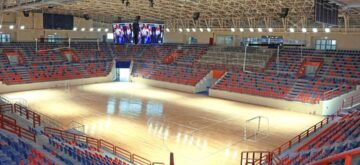
Supplier for major infrastructure milestones including Assuit Airport, Borg Al-Arab industrial complexes, City Escape Mall, and large-scale sports halls.
ISO Quality Assurance
100% aging test compliance, integrating tier-1 LED chips (Bridgelux, Lumileds, Nichia) and premium driver components certified to CE, RoHS, UL, and ATEX standards.
5. Comprehensive FAQ for B2B Industrial Procurement Managers
Below are authoritative responses to the most critical technical and logistical questions asked by global procurement officers and EPC consultants when evaluating industrial lighting fixtures.
L70 represents the operational hours after which an LED drops to 70% of its initial lumen output, while L90 represents the point where output drops to 90%. For critical industrial operations (e.g., precision machining, food inspection), L90 is the industry standard. Look for IES LM-80 test data combined with TM-21 extrapolation software reports calculated at $T_s$ (solder point temperature) matching your plant's peak ambient temperature (+50°C to +65°C). An L90/B10 rating exceeding 60,000 hours ensures 90% of installed fixtures maintain minimum lux levels for over 7 years of 24/7 continuous operation.
Class I, Division 1 is the North American standard (NEC 500) covering locations where ignotable concentrations of flammable gases or vapors exist under normal operating conditions. ATEX Zone 1 (and IECEx) is the European/International standard for atmospheres where explosive gas environments are likely to occur in normal operation. While both require heavy-duty flameproof construction (Ex d) or intrinsic safety (Ex i), ATEX/IECEx requires strict mechanical shock testing, thermal endurance testing, and independent notified body audits (e.g., TÜV, DEKRA). ADM provides dual-certified fixtures meeting both North American and IECEx/ATEX international standards.
Heavy industrial facilities operate large inductive loads (heavy electric motors, arc furnaces, CNC machinery). Cheap LED drivers with high THD (>20%) introduce harmonic noise back into the facility’s power distribution grid, overheating transformers, tripping sensitive circuit breakers, and inducing power utility penalty charges for poor power factor. Premium industrial drivers supplied by ADM incorporate active Power Factor Correction (PFC) circuitry maintaining PF > 0.97 and THD < 8% across wide input voltage ranges (100-277V / 347-480V AC).
Direct glare from high-wattage clear-lens high-bays causes temporary visual impairment for forklift drivers lifting pallets into high rack positions (10-15 meters). International standard EN 12464-1 dictates UGR limits for industrial tasks (typically UGR ≤ 22 for general manufacturing and UGR ≤ 19 for precision work). ADM specifies micro-prismatic glare diffusers, deep-set optical louvers, and frosted tempered glass optics that suppress direct glare without degrading luminous efficacy.
TCO calculation factors in four primary economic components: Initial Capital Expenditure (CapEx), Direct Energy Savings (OpEx), Maintenance & Re-lamping Labor Costs, and HVAC Savings (reduced heat load). The formula is:
TCO = CapEx + (Annual kWh x Electricity Rate x Years) + (Maintenance Costs x Years) - HVAC Heat Reduction Credit
In a typical 400W Metal Halide replacement (500W system draw including ballast) with a 150W ADM LED High-Bay operating 8,760 hours/year, electricity usage drops by 70%. Combined with zero re-lamping labor for 10 years, typical payback periods range between 8 to 14 months.
For standard dry manufacturing, IP65 (dust-tight, water jet resistant) and IK08 (5 Joule impact resistance) are sufficient. For food & beverage processing or chemical facilities subject to high-pressure hot water washdown, IP69K (resistance to 100 bar water pressure at 80°C) with smooth, non-porous cylindrical housing is mandatory to prevent bacterial harborages. For high-vibration areas near drop-hammers, crane runways, or crushers, IK10 rating (20 Joule impact) with vibration-damping mounting brackets is required.
Yes. ADM provides full goniophotometer IES / LDT photometric distribution files for all industrial luminaire lines. Our engineering team builds complete 3D CAD modeling simulations in DIALux EVO, providing detailed false-color rendering maps, illuminance level schedules (Lux/Fc), uniformity ratios ($E_{min}/E_{avg}$), and energy power density (W/m²) compliance documentation tailored to your specific architectural layout.
Ready to Upgrade Your Industrial Facility Lighting?
Contact ADM’s technical sourcing experts today for direct factory pricing, photometric engineering support, and sample evaluations.