
ADM Construction & Lighting Articles
Explore technical insights, architectural lighting trends, and engineering solutions from Egypt's trusted building materials specialist.
10 Tips for Choosing Commercial Ceiling Fixtures
Table of Contents
- Define Commercial Ceiling Fixtures and Their Main Applications
- Assess Ceiling Height, Space Layout, and Installation Requirements
- Compare Fixture Types, Light Output, and Color Temperature
- Evaluate Energy Efficiency, Controls, Durability, and Maintenance
- Confirm Safety Standards, Budget, and Long-Term Operating Costs
- FAQS
- Conclusion
- Related Posts
Choosing Commercial Ceiling Fixtures is not simply a matter of comparing wattage and appearance. The right decision affects visual comfort, energy use, maintenance, safety, and employee performance. A bright showroom can hide glare, uneven illumination, or difficult access during replacement. Real spaces are less forgiving.
The U.S. Department of Energy’s solid-state lighting reports consistently identify efficacy, controls, light quality, and lifetime performance as major priorities. Meanwhile, the International Energy Agency reports that lighting remains a significant electricity-use category worldwide, making efficient commercial upgrades strategically important. Market research from Grand View Research also shows continued growth in the global LED lighting market, reflecting stronger demand for connected, efficient, and adaptable systems. These figures matter, but they do not answer every practical question.
Lighting designer and engineer James R. Benya has described lighting as “both a science and an art.” That principle belongs at the center of fixture selection. A 12-foot office ceiling may need different optics than a retail aisle or a warehouse corridor. Check delivered lumens, beam distribution, color rendering, glare ratings, dimming compatibility, emergency requirements, and rated life. Do not trust wattage alone.
Some specifications look excellent on paper.
Field experience often reveals overlooked problems. A fixture may save energy yet create harsh reflections on monitors. A stylish recessed panel may require expensive ceiling repairs later. This guide examines ten practical tips for choosing Commercial Ceiling Fixtures, while acknowledging an uncomfortable truth: there is no universal best fixture. The strongest choice balances measurable performance with the room’s actual people, surfaces, schedules, and maintenance limits.
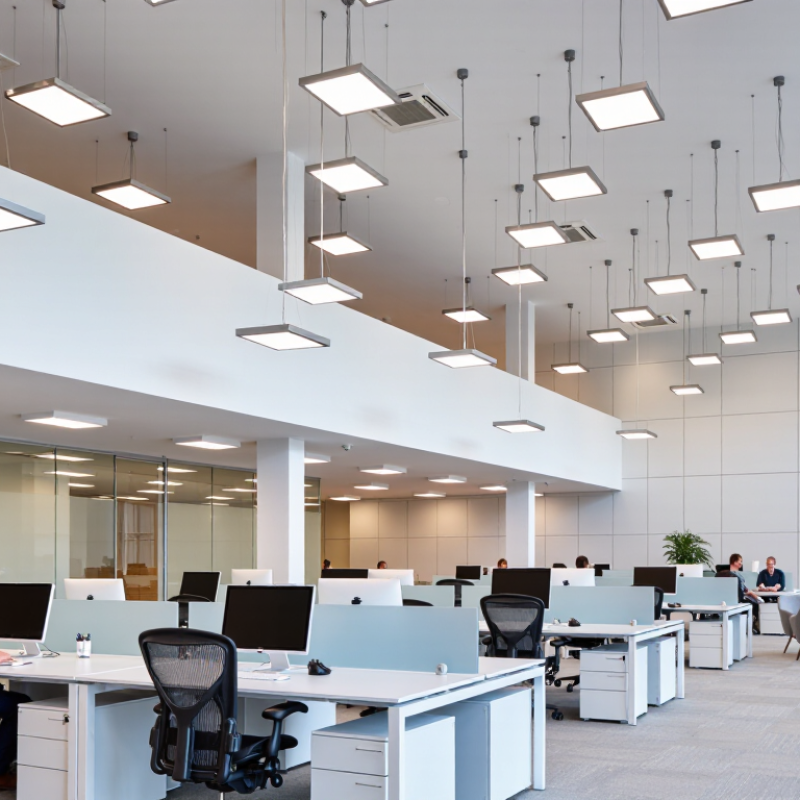
Define Commercial Ceiling Fixtures and Their Main Applications
10 Tips for Choosing Commercial Ceiling Fixtures
Commercial ceiling fixtures are integrated lighting units designed for workplaces, retail stores, schools, healthcare facilities, and public interiors. They may include recessed panels, surface-mounted units, troffers, linear systems, or suspended fixtures. Each type controls light differently across desks, aisles, counters, and circulation zones.
Application changes the selection. A warehouse needs high-bay fixtures with strong vertical illumination. An office needs controlled glare near computer screens. Retail spaces may require adjustable beams for shelves and displays. Moisture-resistant housings suit kitchens, washrooms, and covered outdoor areas. Check ceiling height, mounting structure, cleaning routines, and emergency-lighting requirements before choosing.
Energy performance also matters. The U.S. Department of Energy’s 2023 Solid-State Lighting R&D Opportunities report documents laboratory LED packages exceeding 200 lumens per watt. Real fixtures perform lower. Driver quality, heat, optics, and dirt reduce output. The U.S. Environmental Protection Agency reports that ENERGY STAR-certified LED products use at least 75% less energy than incandescent lighting and can last up to 25 times longer. Commercial fixtures still need careful comparison. Review lumens, watts, color temperature, glare rating, flicker, controls, and warranty terms. ASHRAE Standard 90.1 also provides lighting-power requirements for many commercial buildings. A bright room is not automatically a useful room. I have seen poorly aimed fixtures create sharp reflections on polished floors and dark corners beneath shelving. That mistake deserves a second look.
Assess Ceiling Height, Space Layout, and Installation Requirements
Choosing commercial ceiling fixtures starts above eye level. Measure the finished ceiling, not the structural slab. A 3-meter ceiling may suit broad distribution, while a 6-meter space often needs higher-output fixtures or controlled beam angles. In my site experience, mounting height changes glare, shadow depth, and cleaning access more than product descriptions suggest. Count obstructions too. Beams, ducts, sprinklers, and suspended signs can interrupt an otherwise even lighting plan. The U.S. Energy Information Administration’s 2018 Commercial Buildings Energy Consumption Survey reports that lighting used about 17% of commercial building energy consumption. That makes layout accuracy a financial issue, not merely an aesthetic choice.
Map desks, aisles, counters, and vertical surfaces before selecting fixture spacing. IES guidance emphasizes maintained illuminance, uniformity, and glare control for different visual tasks. A bright center with dim edges can still feel uncomfortable. It happens often. Review reflected ceiling plans with an electrical professional, especially where emergency circuits, controls, or fire-rated assemblies are involved. ASHRAE Standard 90.1-2022 also sets lighting power and control requirements for many commercial applications, so wattage and zoning deserve early review. Leave service clearance around drivers and junction boxes. Installation access is easy to underestimate. I learned that after a lift was needed for a fixture positioned beside an inaccessible duct. The original layout worked on paper, but not on site. Recheck it.
| Tip | What to Assess | Practical Guideline | Recommended Fixture Approach | Installation Requirement |
|---|---|---|---|---|
| 1Measure Ceiling Height | Finished floor-to-ceiling height and the usable clearance below the fixture. | Standard offices commonly use ceilings around 2.7–3.0 m (9–10 ft). Higher spaces may require suspended or high-output solutions. | Use low-profile fixtures for lower ceilings and suspended or pendant fixtures where extra vertical volume is available. | Confirm the final fixture depth, suspension length, and minimum head clearance before ordering. |
| 2Map the Space Layout | Room dimensions, work zones, circulation paths, partitions, shelving, and equipment locations. | Arrange fixtures in a regular grid where possible, while aligning them with desks, aisles, or task areas. | Select linear, recessed, surface-mounted, or suspended fixtures according to the ceiling grid and room geometry. | Coordinate fixture locations with ceiling tiles, access panels, ducts, sprinklers, and structural members. |
| 3Match Light Levels to Tasks | The visual demands of the activity, including reading, computer work, storage, or detailed inspection. | Typical maintained illuminance targets are approximately 300–500 lux for many offices and 500 lux or more for detailed tasks, subject to local standards. | Choose the fixture output and optical distribution based on the required task illuminance rather than wattage alone. | Use a lighting calculation or field measurement to verify uniformity and maintained light levels. |
| 4Control Glare | Computer screens, reflective surfaces, viewing angles, and the position of occupants relative to the fixture. | Look for suitable shielding, diffusers, or optical systems and avoid placing bright sources directly in common viewing directions. | Use low-glare optics, diffused lenses, or fixtures with controlled luminance for offices and screen-based work areas. | Review glare ratings, fixture orientation, and mounting position during the layout stage. |
| 5Check Color Quality | The importance of accurate color recognition and the atmosphere required in the space. | A color rendering index of 80 or higher is commonly suitable for general commercial areas; more demanding applications may require higher performance. | Select a consistent color temperature, commonly around 3500–4000 K for offices and general commercial interiors. | Specify color consistency across all fixtures and verify compatibility with existing lighting. |
| 6Review Energy Performance | Operating hours, fixture wattage, controls, and the number of fixtures required for the target light level. | Compare delivered lumens per watt, expected service life, standby power, and control capabilities. | Prioritize efficient LED fixtures with dimming, occupancy sensing, or daylight-responsive control where appropriate. | Confirm the electrical load, control wiring, driver compatibility, and commissioning requirements. |
| 7Verify Ceiling Compatibility | Ceiling type, module size, surface condition, plenum depth, and available support points. | Common ceiling systems include exposed structure, suspended grid, gypsum board, and concrete decks; each requires a different mounting method. | Choose recessed fixtures for compatible grid or framed ceilings and surface or suspended fixtures for solid or exposed structures. | Use independent safety support where required and never rely solely on fragile ceiling tiles to carry fixture weight. |
| 8Plan Access and Maintenance | How lamps, drivers, lenses, and electrical connections will be reached after installation. | Keep service areas accessible and avoid placing fixtures where maintenance would obstruct critical operations. | Use fixtures with accessible components, replaceable drivers, and easy-to-remove lenses when long-term serviceability matters. | Coordinate with access panels, lift equipment, maintenance clearances, and building operating schedules. |
| 9Account for Safety Conditions | Moisture, dust, heat, impact risk, emergency egress, and fire-protection requirements. | Indoor dry areas, damp areas, kitchens, warehouses, and industrial spaces may require different environmental ratings. | Use appropriately rated housings and sealed designs in locations exposed to moisture, dust, or accidental impact. | Confirm electrical safety, fire-rating, emergency-lighting, and local code requirements with a qualified professional. |
| 10Confirm Controls and Future Flexibility | Occupancy patterns, daylight availability, zoning needs, renovation plans, and future layout changes. | Divide large areas into logical control zones so lighting can respond to occupancy and daylight conditions. | Select fixtures and control components that support dimming, scheduling, occupancy detection, or daylight harvesting when beneficial. | Define control zones, communication requirements, commissioning steps, and future access before installation begins. |
Compare Fixture Types, Light Output, and Color Temperature
10 Tips for Choosing Commercial Ceiling Fixtures
Fixture type should follow the ceiling, task, and mounting height. Recessed troffers suit regular office grids, while linear fixtures support open-plan layouts. High bays deliver stronger output for warehouses and tall spaces. Compare delivered lumens, not only lamp ratings. Lens losses, dirt, and ceiling height reduce useful light.
The U.S. Energy Information Administration reported that lighting used 17% of electricity in commercial buildings in its 2018 CBECS analysis. Efficient selection matters. The U.S. Department of Energy’s 2023 solid-state lighting forecast estimated LEDs represented about 48% of general-illumination installations in 2020. Still, wattage alone proves little. Check lumens per watt, distribution, glare control, dimming, and lumen maintenance. A commissioning test with a handheld meter can reveal dark desks or overlit aisles.
Color temperature changes the room’s visual character. Around 3000K can feel calm and hospitality-oriented, while 3500K to 4000K often supports offices and classrooms. Higher settings may appear crisp, but they can feel harsh under reflective ceilings. IES guidance connects lighting quality with visual comfort, task needs, and glare control. Color rendering matters too; review the reported CRI and, where appearance is critical, more detailed color metrics. The calculation will not be perfect. Verify samples onsite, because wall finishes, daylight, and personal sensitivity can change the result. Be cautious with one-size-fits-all specifications.
10 Tips for Choosing Commercial Ceiling Fixtures
Compare fixture types, typical light output, and recommended color temperature
The chart uses representative, brand-neutral specifications commonly found in commercial lighting. LED high bays provide the highest light output for large spaces, while troffers and flat panels are commonly used in offices. Neutral white light around 4000K is a versatile choice for most workplaces, while 5000K is often selected for warehouses and industrial areas.
Evaluate Energy Efficiency, Controls, Durability, and Maintenance
Commercial ceiling fixtures deserve more than a wattage comparison.
Check delivered lumens, efficacy, glare control, and color consistency. The U.S. Department of Energy reports that LED lighting can use at least 75% less energy than incandescent lighting and last up to 25 times longer. That advantage shrinks when poor optics create dark work areas. Measure light at desks, aisles, and shelves before final approval.
A bright ceiling is not always a useful ceiling.
Controls should match real occupancy patterns.
Occupancy sensors can reduce wasted runtime in meeting rooms, storage areas, and restrooms. Daylight harvesting can lower output near windows, but only after proper commissioning.
People override systems when settings feel uncomfortable.
Durability affects maintenance budgets more than brochure claims.
Review operating temperature, driver quality, ingress protection, and published lifetime testing. The DesignLights Consortium’s technical requirements emphasize performance testing and controllability for qualifying commercial products.
A ten-year warranty sounds reassuring, yet exclusions may matter more. I would also inspect one installed sample after several weeks. Dust, flicker, and uneven dimming often appear after the showroom visit.
Confirm Safety Standards, Budget, and Long-Term Operating Costs
Choosing commercial ceiling fixtures requires more than comparing brightness and purchase prices. Confirm compliance with applicable electrical and fire-safety requirements, including NFPA 70 and local inspection rules. Check mounting hardware, grounding, emergency-lighting compatibility, and the fixture’s rated operating temperature. A loose fixture above a busy aisle is not a minor inconvenience. It is a safety risk.
Budget for the entire life cycle. The U.S. Department of Energy reports that LED lighting can use up to 75% less energy than incandescent lighting and last up to 25 times longer. However, actual savings depend on operating hours, controls, and maintenance. A warehouse running 12 hours daily needs different calculations than a small office. Ask for verified photometric data, warranty terms, driver replacement costs, and expected lumen maintenance. Do not trust attractive wattage claims alone.
Controls deserve careful attention. Occupancy sensors and daylight dimming can reduce unnecessary runtime, while poor commissioning may create dark corners or frequent cycling. The U.S. Energy Information Administration identifies lighting as a significant electricity use in commercial buildings, making control strategy financially important. During a site review, stand beneath the proposed fixture and inspect glare, shadows, and access for maintenance. This simple step is often skipped. It should not be. A cheaper fixture may still become expensive when lifts, labor, and early replacements are added. Recheck the numbers before approval.
FAQS
They are integrated lighting units for workplaces, stores, schools, clinics, and public interiors. Common types include recessed panels, surface-mounted units, troffers, linear systems, and suspended fixtures.
High-bay fixtures usually suit tall warehouses. Strong vertical illumination helps workers see shelves, labels, and equipment. Check ceiling height before choosing.
Choose fixtures with controlled glare near computer screens. Test the light from seated positions. Brightness alone is not enough.
Adjustable beams can highlight shelves, counters, and displays. Aim fixtures carefully. Poor aiming may create reflections and dark corners.
They are useful in kitchens, washrooms, and covered outdoor areas. Confirm the fixture’s environmental rating. A damp location needs more protection than a dry office.
Compare lumens, watts, color temperature, glare rating, flicker, controls, warranty terms, and expected lumen maintenance. Verified photometric data is valuable. Attractive wattage claims can mislead.
Occupancy sensors turn lights off in empty areas. Daylight dimming reduces unnecessary output near windows. Poor commissioning may cause dark corners or frequent cycling.
Confirm electrical and fire-safety compliance with applicable local requirements. Check grounding, mounting hardware, operating temperature, and emergency-lighting compatibility. A loose fixture above an aisle is a real risk.
Include purchase price, energy use, maintenance, lift access, labor, driver replacement, and early failures. A cheaper fixture may cost more over time. Recheck the numbers before approval.
Stand beneath the proposed fixture and inspect glare, shadows, coverage, and maintenance access. Look beneath shelving too. I might overlook these details without a physical check.
Conclusion
Choosing the right Commercial Ceiling Fixtures requires more than selecting an attractive design. Start by understanding their main applications, such as offices, retail spaces, schools, healthcare facilities, warehouses, and other commercial environments. Evaluate the ceiling height, room dimensions, layout, mounting conditions, wiring access, and installation requirements to ensure suitable coverage and safe placement. Compare fixture types based on light output, beam distribution, glare control, and color temperature so the lighting supports both visibility and the intended atmosphere.
A complete evaluation should also consider energy efficiency, dimming or automated controls, construction quality, durability, and ease of maintenance. Fixtures designed for frequent use should provide reliable performance and convenient access for cleaning or replacement. Before making a final decision, confirm that the products meet applicable safety and electrical standards, fit the project budget, and offer reasonable long-term operating costs. Considering purchase price, energy consumption, maintenance needs, and expected service life together can lead to a more practical and cost-effective lighting solution.

Blog Tags: