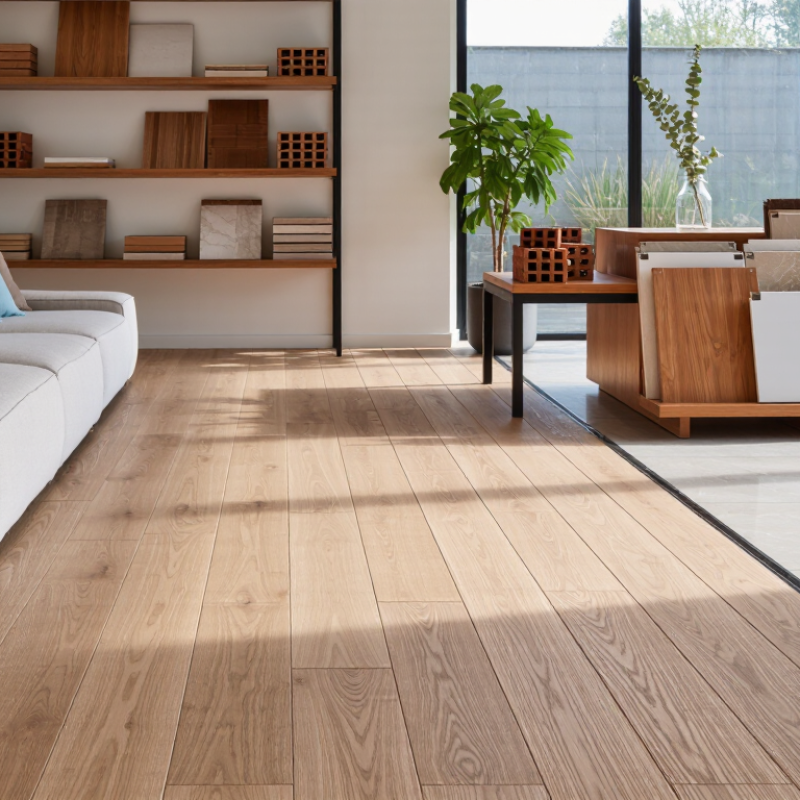
Choosing Interior Construction Materials is not just a finish decision. Materials influence durability, comfort, maintenance, cost, and the character of a room. A pale oak floor, for example, feels different underfoot than polished stone, and each responds differently to spills, sunlight, and daily wear.
Architect Louis Kahn captured the importance of understanding materials: “You say to brick, ‘What do you want, brick?’ And brick says to you, ‘I like an arch.’” His words point to a practical principle: each material has strengths and limitations. The right choice depends on the room, the building, the people using it, and the work required to install it.
Start with the conditions. Is the space damp, busy, sunny, or likely to need frequent cleaning? Compare product specifications, maintenance instructions, installation requirements, and credible performance information. Check samples in the actual room; showroom lighting can flatter a surface. A sample can still mislead. Color and texture may shift across a large area, and the finished result depends on workmanship.
There is no universal best material. A beautiful surface may demand more care than a household can manage. A cheaper option may cost more over time if it wears quickly or needs replacement. The following outline explores how to weigh performance, appearance, budget, sustainability, and site conditions—then make a choice that fits the project, not just the mood board. Some trade-offs remain. That is worth admitting.
Define room-by-room needs and check ASTM E84 Class A limits: FSI 0–25, SDI ≤450
Interior material choices should start with how each room is used. A busy hallway needs surfaces that handle scuffs and frequent cleaning. A bedroom may call for different acoustic and finish priorities. Before selecting a wall or ceiling product, check its fire-test documentation. ASTM E84 measures flame spread and smoke development across a material’s surface under specific test conditions. For Class A, the Flame Spread Index (FSI) is 0–25, and the Smoke-Developed Index (SDI) must be 450 or lower. Check the actual report, not just a sales description. Test results apply to the tested product and installation details.
Tips: Match the report to the proposed thickness, backing, and mounting method. Keep the documentation with the project records. Small differences matter.
A rating alone does not describe every fire risk or predict performance in a real building. Confirm applicable project requirements with the design team or building official. I have seen finish schedules list a product without noting its tested configuration; that gap is easy to miss. It is worth checking before ordering, especially where ceilings, wall cavities, or unusual substrates are involved. Also weigh durability, cleaning needs, and room use. A compliant finish can still be a poor practical choice if it chips quickly or is difficult to maintain.
Compare insulation R-values and sound absorption using ASTM C423 NRC ratings (0–1)
Interior materials must manage both heat and sound. Keep those metrics separate. The U.S. Department of Energy’s Energy Saver guidance defines R-value as resistance to heat flow: higher values indicate greater insulating effectiveness. Its recommended attic insulation ranges roughly from R-30 to R-60, depending on climate and home conditions. Compare materials at the same thickness, and check gaps around studs, pipes, and window frames. Small gaps matter. A stated R-value cannot describe every installation detail.
For sound absorption, ASTM C423 measures materials in a reverberation room. The Noise Reduction Coefficient, or NRC, averages absorption coefficients at 250, 500, 1,000, and 2,000 hertz, rounded to the nearest 0.05. On the commonly used 0–1 scale, NRC 0.80 suggests more mid-frequency absorption than NRC 0.20. It does not promise a quiet room. A ceiling panel may soften reflected speech yet do little for low bass. That comparison is imperfect.
Read both numbers alongside the test conditions and intended location. A thick wall assembly can improve thermal resistance, while a hard exposed surface still reflects conversation. Check whether the tested sample matches the installed thickness and mounting method; ASTM C423 results depend on specimen setup. On site, look for seams, compressed insulation, and bare edges. The paperwork is useful, but not the whole wall.
Screen material emissions using California’s CDPH Standard Method for VOCs
Choosing interior materials by smell is unreliable. A faint odor can linger, while some emissions are hard to detect. The U.S. EPA’s TEAM study reported that levels of many common organic pollutants were about two to five times higher indoors than outdoors. That finding is old, but still useful context: materials deserve scrutiny before installation.
California’s CDPH Standard Method v1.2-2017 offers a more structured screen. It tests product emissions in an environmental chamber, then estimates indoor concentrations under defined room-use conditions. Results are assessed against health-based exposure limits for individual chemicals, not just a single total-VOC number. Ask for the full test report, product category, and tested formulation; a certificate alone may not show what was measured. Check that the material supplied matches the tested product, including backing, finish, or adhesive. Details matter.
Look closely at flooring, coatings, cabinets, and wall finishes, especially in small rooms with limited ventilation. A compliant test result is useful, not a promise of zero emissions. Installation choices can change exposure. So can fresh paint nearby. I would also avoid treating “low-VOC” as a complete answer; it may describe one measure, not every emitted chemical. The method has limits, and real rooms are messier than chambers.
Assess mold resistance with ASTM D3273’s 0–10 rating scale
How to Choose Interior Construction Materials
Assess mold resistance with ASTM D3273’s 0–10 rating scale. ASTM D3273 tests how well interior coatings resist mold growth in a controlled, warm, humid chamber. A rating of 10 indicates no visible mold growth; lower scores indicate more growth. Think of the scale as a screening tool, not a promise about a finished room. The test evaluates a coating, not every part of a wall assembly. It cannot account for a leaking pipe, damp drywall, or poor ventilation.
For a bathroom ceiling or laundry-room wall, compare products tested under the same method and check the stated rating. Then consider moisture control: the U.S. Environmental Protection Agency advises keeping indoor humidity below 60%, ideally between 30% and 50%. A high D3273 score is useful, but it cannot compensate for persistent condensation or water intrusion.
That distinction matters. A lab score can look reassuring while a cold corner stays wet through winter. I would also check whether the test result applies to the exact coating and substrate being considered; that detail is easy to miss. Industry testing gives a consistent comparison, though real rooms are less predictable.
Compare verified environmental impacts using ISO 14025 and EN 15804 EPDs
When choosing interior construction materials, an Environmental Product Declaration (EPD) can replace vague “eco-friendly” claims with documented impact data. ISO 14025 sets principles for Type III environmental declarations, while EN 15804 provides core rules for construction product EPDs. Many EPDs are independently verified, but check the declaration and its verification details.
Compare like with like. A flooring EPD may report impacts per square metre, while another uses a different declared unit. Check the product category rules, life-cycle stages included, geography, and publication date. Look for modules covering production, transport, installation, use, and end of life. If one declaration excludes installation waste and another includes it, the figures do not tell the same story. Small detail, big difference.
For a practical comparison, place the EPDs beside project quantities and expected service life. A durable wall finish may need fewer replacements, but the EPD alone cannot confirm how it will perform in a particular room. Review several impact indicators, not just carbon emissions, and note any assumptions. I find this part easy to rush. It deserves a second look. EPDs support informed choices; they do not declare one material universally best. A clear comparison makes uncertainty visible, which is more useful than pretending every number is exact.
How to Choose Interior Construction Materials — Compare Verified Environmental Impacts Using ISO 14025 and EN 15804 EPDs
Use this reference table to compare environmental product declarations (EPDs) for interior construction materials. ISO 14025 establishes principles for Type III environmental declarations; EN 15804 provides core product-category rules for construction-product EPDs. Indicator results are product-specific, so compare values from the actual EPDs rather than assuming that a material category has one universal impact value.
Environmental impact indicators commonly reported in EN 15804+A2 EPDs
| Impact dimension |
EN 15804+A2 indicator |
Reported unit |
How to use it when comparing materials |
| Climate change |
GWP-total; also reported as GWP-fossil, GWP-biogenic, and GWP-luluc |
kg CO2 equivalent |
Compare the same indicator for the same declared or functional unit and the same life-cycle modules. Review the component indicators as well as the total. |
| Ozone depletion |
ODP |
kg CFC-11 equivalent |
Compare results using matching product scope, modules, and EPD rules. |
| Acidification |
AP |
mol H+ equivalent |
Use the reported value as an indicator of potential acidifying emissions; it is not a direct measure of site-specific effects. |
| Eutrophication |
EP-freshwater |
kg P equivalent |
Keep this separate from marine and terrestrial eutrophication indicators. |
| Eutrophication |
EP-marine |
kg N equivalent |
Compare only with the same eutrophication compartment and indicator. |
| Eutrophication |
EP-terrestrial |
mol N equivalent |
Do not combine or substitute this result for freshwater or marine eutrophication. |
| Photochemical ozone formation |
POCP |
kg NMVOC equivalent |
Compare values reported for the same indicator and life-cycle scope. |
| Resource use |
ADP-minerals & metals |
kg Sb equivalent |
Use alongside other impact indicators; it does not represent total material consumption. |
| Resource use |
ADP-fossil |
MJ |
Compare on an equivalent product quantity and matching modules. |
| Water use |
WDP |
m3 world equivalent deprived |
Interpret as a scarcity-weighted water-use indicator, not simply litres of water consumed. |
Checks to make before comparing interior-material EPD results
| Comparison dimension |
What to check in each EPD |
Why it matters |
| Declared or functional unit |
Record the unit exactly as stated, such as mass, area, or volume, and confirm any performance specification attached to it. |
Results expressed for different quantities or functions cannot be compared directly without a justified conversion. |
| Life-cycle modules |
Check whether results cover A1–A3 (product stage), A4 (transport to site), A5 (installation), B modules (use stage), C modules (end of life), and module D (benefits and loads beyond the system boundary). |
A result for A1–A3 alone does not include the same life-cycle stages as a result covering installation or end of life. Keep module D distinct from A–C totals. |
| Product category rules |
Check the cited PCR, EN 15804 version, and any complementary category rules used by the EPD. |
Rules and calculation methods need to be sufficiently aligned for a meaningful comparison. |
| Geography and production period |
Review the declared manufacturing geography, data coverage, and validity dates shown in the EPD. |
Energy supply, transport, and production data can vary by region and reporting period. |
| Verification and program information |
Confirm that the document is a published EPD, identifies its applicable rules, and states its verification status and validity period. |
An EPD is a structured environmental declaration; verification and rule alignment support confidence in the reported data. |
| Installation and end-of-life assumptions |
Review stated installation losses, service-life assumptions, maintenance, replacement, disposal routes, and recycling scenarios where reported. |
These assumptions can affect whole-life comparisons, particularly when the chosen system boundary extends beyond the product stage. |
Comparison note: This table lists standard indicator names, units, and comparison checks; it does not assign generic impact scores to material types. Environmental results vary by product, manufacturing process, declared unit, EPD rules, and life-cycle scope. Use current, applicable EPDs and compare like with like.
Conclusion
Choosing Interior Construction Materials starts with understanding how each room will be used. Consider durability, comfort, moisture exposure, and safety, then compare product documentation against relevant performance measures. For fire performance, check ASTM E84 results: Class A materials have a flame spread index (FSI) of 0–25 and a smoke-developed index (SDI) of 450 or less. Compare insulation R-values for thermal resistance and ASTM C423 noise reduction coefficient (NRC) ratings, which range from 0 to 1, to evaluate sound absorption.
Also review indoor-air and moisture performance. California’s CDPH Standard Method provides a way to screen material emissions, including volatile organic compounds (VOCs). ASTM D3273 rates resistance to mold growth on a 0–10 scale. To consider environmental impacts, compare verified Environmental Product Declarations prepared under ISO 14025 and EN 15804. Weighing these measures together helps match materials to a room’s needs rather than relying on a single rating.