
Knowledge Hub & Insights

ADM Construction & Lighting Articles

Explore technical insights, architectural lighting trends, and engineering solutions from Egypt's trusted building materials specialist.

0%

A sports hall can look bright and still be difficult to use. Players may lose sight of a fast ball beneath a dark roof, while glare from a poorly aimed fitting distracts spectators. Choosing Sports Hall Lighting Systems means considering more than brightness. Uniformity, glare control, colour quality, ceiling height, and maintenance all shape what people see on court.

Lighting researcher Peter Boyce’s work offers a useful principle, paraphrased here: “Good lighting helps people see clearly without drawing attention to itself.” This is not presented as a verbatim quotation. It captures a practical test for any proposal: can players track the ball, officials judge movement, and spectators watch comfortably from different seats? Ask for measured lighting data, not just a confident promise. A lighting plan should show how fittings are positioned and how illumination reaches the court, sidelines, and activity zones. Small details matter. A shiny floor can reflect a bright source straight into a player’s eyes.

The ten tips ahead will help compare systems, controls, energy use, installation needs, and long-term upkeep. They also consider a common oversight: a hall used for school sport may later host tournaments or community events. Needs change. No checklist replaces a site assessment, and even careful planning can miss something. That is worth remembering before committing to equipment.
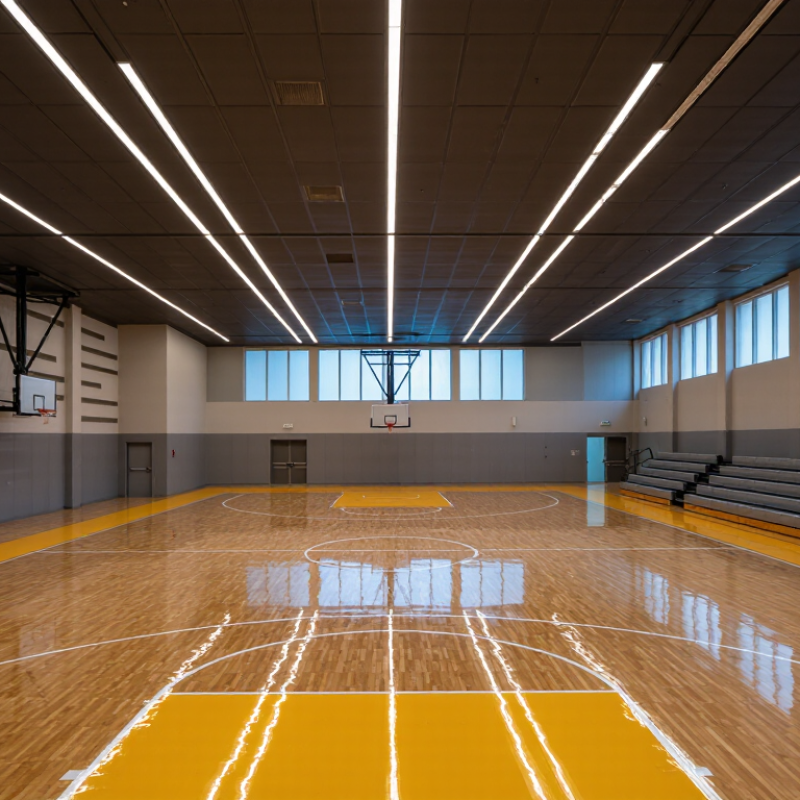
10 Tips for Choosing Sports Hall Lighting Systems?

Define Lighting Needs for Sports and Hall Activities

Before choosing a sports hall lighting system, define the activities, not just the room size. Basketball, badminton, gymnastics, and school events create different visual demands. EN 12193:2019 lists 750 lux for top-level indoor basketball, 500 lux for medium-level use, and 200 lux for recreational activity. It also recommends stronger uniformity at higher levels. A player should not move from a bright court into a distracting dark patch. Measure the playing surface at several points, including corners and goal areas. Real halls often have uneven ceilings, old skylights, and changing wall colors. The drawing may look perfect. The floor can disagree.

Consider the audience and camera position. Recreational users need comfortable visibility, while televised competitions require controlled glare and stable color performance. CIE 150:2017 identifies glare and spill light as key factors in sports lighting design. In practice, shielded optics help protect players looking upward during a serve or rebound. Select a suitable color appearance, flicker performance, dimming range, and emergency-lighting arrangement. The U.S. Department of Energy reports that LED systems can reduce lighting energy use substantially compared with older technologies, but savings depend on controls and operating hours. That part is easy to overpromise. Test the system during real activities, with players, spectators, and cameras present. A lighting plan that works on paper may still feel harsh during an evening match.

Assess Hall Dimensions, Layout, and Existing Infrastructure

10 Tips for Choosing Sports Hall Lighting Systems: Assess Hall Dimensions, Layout, and Existing Infrastructure

Measure the hall before comparing lighting products. Record length, width, ceiling height, beam obstructions, wall colors, and playing zones. A badminton court needs different aiming angles than a basketball court. High ceilings may require narrow optics, while low roofs can create harsh glare.

EN 12193:2019 recommends maintained illuminance levels from 300 lux for recreational use to 750 lux for major competition. Uniformity matters too. Dark patches quickly affect player reactions and camera images.

Inspect the existing infrastructure carefully. Check cable routes, circuit capacity, mounting points, emergency lighting, and control compatibility. An experienced installer should test voltage stability and photograph every ceiling connection.

CIBSE LG4 highlights the importance of uniformity, glare control, and maintenance factors in sports facilities. A clean-looking ceiling can still hide overloaded circuits or weak fixings. Do not assume old wiring is suitable for new loads.

Map the fixture positions against court lines and spectator seating. Avoid placing bright sources directly above players’ sightlines. Use a lighting simulation, then compare it with measurements from a calibrated lux meter.

The U.S. Department of Energy reports that LED systems commonly deliver over 100 lumens per watt, but efficiency alone does not guarantee good sports lighting. I have seen plans that met average lux targets yet produced distracting glare.

That mistake deserves a second review.

Consider dimming zones, daylight sensors, and simple controls for training, competition, and cleaning.

Compare Lighting Technologies, Controls, and Energy Use

Choosing sports hall lighting requires more than counting fixtures. Compare LED, fluorescent, and discharge technologies by efficacy, glare, flicker, maintenance, and replacement access. The International Energy Agency’s Energy Efficiency 2023 report states that lighting uses about 15% of global electricity. Efficient equipment matters.

Modern LED systems commonly deliver around 100–200 lumens per watt, according to the U.S. Department of Energy’s Solid-State Lighting R&D Opportunities report. However, efficiency alone can mislead. A bright floor with dark walls still feels uncomfortable. Check uniformity, vertical illumination, colour consistency, and flicker during fast ball movement. High-speed cameras can reveal problems that ordinary site inspections miss. Small details matter.

Controls often deliver the clearest savings. Occupancy sensors can reduce lighting in empty training zones, while daylight sensors respond near rooflights. Dimming scenes should support badminton, basketball, cleaning, and televised events. The IEA reports that connected lighting can improve energy performance through scheduling and automatic control. Yet sensors may switch off during quiet coaching sessions. That is an avoidable failure. Test settings with staff, not only software.

Choose fittings with accessible drivers, documented lifetime data, and suitable impact protection. Review power density in watts per square metre, not just fixture price. A 2023 U.S. Department of Energy analysis notes that controls, maintenance, and operating schedules strongly influence lifecycle costs. Energy models are useful, but never perfect. Dust, aging surfaces, and user habits change real consumption. Record lux levels and electricity use after installation, then adjust the system.

Sports Hall Lighting: Energy Use by Technology

Estimated electricity use to deliver the same amount of light. LED is set to 100%; lower values indicate less energy use. Actual results vary with fixture efficacy, layout, dimming, and operating hours.

Check Visibility, Safety, Standards, and Installation Costs

10 Tips for Choosing Sports Hall Lighting Systems

Check Visibility, Safety, Standards, and Installation Costs

When choosing sports hall lighting, test visibility from the player’s viewpoint, not only from the floor plan. A badminton shuttle can disappear against a bright roof. A basketball player needs clear facial detail during a fast pass. Check maintained illuminance, uniformity, glare control, and color rendering. Ask for a photometric layout based on the actual ceiling height and court markings. Flicker matters too, especially during video recording. Some low-cost systems look bright but create dark corners and harsh reflections. Visit a similar hall if possible. Stand beneath the fixtures. Move across the court. That practical check can reveal problems that software misses.

Safety depends on more than light output. Confirm local sports-lighting standards, emergency-lighting rules, electrical requirements, and accessibility provisions with a qualified professional. The correct system should support safe exits, clear boundaries, and reliable operation after partial failure. Request test records, product data, control settings, and a realistic maintenance plan. Installation costs may include lifts, cable routes, structural supports, controls, commissioning, and future driver replacement. Get these items priced separately. A cheap quotation may exclude ceiling reinforcement or nighttime installation. That mistake becomes expensive. Energy use also deserves attention; occupancy sensors and dimming can reduce waste, but poorly configured controls may interrupt training. I have seen estimates ignore cleaning and re-aiming after construction dust. Leave room for those costs. Review the proposal with the facility manager, installer, and users before approving it. Their priorities rarely match perfectly.

10 Tips for Choosing Sports Hall Lighting Systems? — Check Visibility, Safety, Standards, and Installation Costs
Tip What to Check Why It Matters Practical Action Cost or Installation Consideration
1. Match lighting to the sports played Consider the ball’s speed, size, playing area, and whether athletes need to track high balls. Different sports place different demands on visibility, vertical illumination, and uniformity. List the sports and competition levels the hall must support before requesting a lighting design. A multi-sport hall may need a more flexible design and additional lighting controls.
2. Set the required illuminance Check maintained illuminance requirements for the intended activity and competition level. Insufficient light can impair visibility; excessive light can waste energy and increase glare. Use a lighting calculation based on the applicable sport, venue, and governing requirements rather than relying on a single generic target. The required light output affects the number, type, and mounting arrangement of luminaires.
3. Check uniformity across the playing area Review the distribution of light and the difference between brighter and darker areas. Even illumination helps players follow the ball and move safely throughout the court. Request a lighting layout showing calculated illuminance points over the full playing area. A well-planned layout can reduce the need for extra fixtures to correct dark zones later.
4. Control glare and visual discomfort Assess glare from player viewpoints, including when looking upward toward a ball. Direct or reflected glare can distract players and make it harder to see clearly. Ask for glare assessment and check luminaire positions, aiming angles, and shielding in the design. Optics and mounting choices may affect fixture cost, but can help avoid costly repositioning.
5. Review colour quality Check colour rendering and colour consistency for the activities taking place. Good colour quality supports clear recognition of players, equipment, and markings. Compare the proposed colour-rendering data and colour appearance with the venue’s needs. Higher colour-quality requirements may influence product selection and project budget.
6. Consider flicker and video use Check whether lighting performance is suitable for cameras, recording, or slow-motion video. Some lighting systems can produce visible or camera-detected flicker, depending on their drivers and operating conditions. If the hall is used for filming or broadcast, request relevant flicker data at the intended settings. Camera-ready performance may require specific drivers, controls, or commissioning checks.
7. Follow applicable standards Identify the relevant national requirements and sport-specific guidance; EN 12193 is a European standard for lighting of sports facilities. Standards help define lighting criteria for different sports and levels of use. Have a qualified lighting designer confirm which standard, edition, and requirements apply to the project. Compliance can affect design, testing, documentation, and commissioning costs.
8. Check safety, mounting, and maintenance access Review ceiling structure, mounting height, impact risk, access equipment, and electrical safety. Secure installation and practical servicing help protect users and maintenance staff. Coordinate the lighting design with structural, electrical, and building-maintenance teams. High ceilings, restricted access, or structural upgrades can increase installation costs.
9. Compare energy use and controls Compare connected load, operating hours, dimming capability, and control options. Efficient fixtures and appropriate controls can reduce electricity use when the hall is not at full activity. Request an energy estimate based on realistic schedules, occupancy, and operating settings. Controls may add upfront cost but can reduce operating costs when used effectively.
10. Assess total installation and lifecycle cost Include fixtures, wiring, controls, access equipment, commissioning, maintenance, and expected replacements. The purchase price alone does not show the full cost of operating a lighting system. Compare itemised proposals using the same design assumptions and scope of work. Request a clear breakdown of supply, installation, commissioning, maintenance, and any building work.

Plan System Maintenance, Upgrades, and Long-Term Performance

10 Tips for Choosing Sports Hall Lighting Systems: Plan System Maintenance, Upgrades, and Long-Term Performance

A sports hall needs more than bright fixtures. It needs stable illumination, safe glare control, and predictable maintenance. Start with a five-year asset plan. Record operating hours, failed drivers, lux readings, and emergency-light tests every quarter. The International Energy Agency reported that buildings consumed about 30% of global final energy in 2022, so efficient operation deserves regular attention. Small scheduling errors can become expensive.

Choose luminaires with replaceable drivers, accessible wiring, and documented photometric data. Keep spare drivers and control components on site. A dark court during a tournament is not a minor inconvenience. The U.S. Department of Energy’s 2023 solid-state lighting forecast highlights efficiency gains from improved LEDs and controls, while laboratory efficacy has exceeded 200 lumens per watt. Real installations perform lower. That gap needs honest measurement.

Plan upgrades around school holidays or seasonal closures. Recheck uniformity after replacing only part of a ceiling; mixed generations can create uneven color and glare. Sensor settings also need review after furniture, curtains, or court layouts change. I have seen systems save energy on paper but frustrate players because dimming responded too slowly. That is a useful warning. Keep commissioning records, compare annual energy data, and budget for controls before failures force rushed decisions.

FAQS

What lighting level does a sports hall need?

It depends on the activity. The article cites 200 lux for recreational basketball, 500 lux for medium-level use, and 750 lux for top-level play.

Why does lighting uniformity matter?

Uneven light can create dark patches that affect reactions and camera images. Check several points, including corners and goal areas.

How should I assess glare?

Stand on the court and look upward from a player’s viewpoint. Shielded optics can reduce glare during serves and rebounds.

What should I measure before selecting fixtures?

Record hall dimensions, ceiling height, beams, court lines, wall colors, and existing mounting points. A tidy plan may miss a real obstruction.

Is high efficiency enough to guarantee good lighting?

No. Lumens per watt do not reveal glare, dark corners, or poor visibility. Compare a lighting simulation with calibrated lux-meter readings.

What should I check in the existing electrical setup?

Review circuit capacity, cable routes, voltage stability, emergency lighting, and fixture supports. Old wiring may not suit a new system.

How can I check whether lighting works for players and cameras?

Test it during real activities, from court level and camera positions. Check flicker, color appearance, facial detail, and shuttle visibility.

Which costs should a lighting proposal include?

Ask for separate prices for installation, lifts, cabling, structural supports, controls, commissioning, and future driver replacement. Cleaning and re-aiming can be overlooked.

Can sensors and dimming reduce energy use?

They can, depending on operating hours and settings. Poorly configured controls may interrupt training, so test the controls with users.

What records should I request before approval?

Request photometric layouts, test records, product data, control settings, and a maintenance plan. Review them with the facility manager and installer.

Conclusion

Choosing the right Sports Hall Lighting Systems requires a clear understanding of how the space will be used, from training and community activities to competitive events. Start by identifying required brightness, uniformity, glare control, and color quality for each sport. Then evaluate the hall’s dimensions, ceiling height, layout, natural light, electrical capacity, and existing fixtures to ensure the proposed system fits the facility efficiently.

Compare suitable lighting technologies, control options, energy consumption, and operating costs before making a decision. Safety and visibility should remain priorities, with attention to flicker, shadows, emergency lighting, and relevant performance standards. Installation expenses, access equipment, and possible disruptions should also be included in the budget. Finally, select a system that supports easy cleaning, routine maintenance, future upgrades, and reliable long-term performance. A well-planned solution can improve user comfort, reduce energy waste, simplify management, and provide consistent illumination for many years.
Liam

Liam

Liam is a dedicated marketing professional with a deep expertise in our company's products and services. With a keen eye for detail and a passion for effective communication, he plays a pivotal role in shaping our online presence through regular updates to our professional blog. Liam is committed......