
ADM Construction & Lighting Articles
Explore technical insights, architectural lighting trends, and engineering solutions from Egypt's trusted building materials specialist.
10 Best Airport Infrastructure Lighting Solutions?
Table of Contents
- Airport Lighting Requirements and Evaluation Criteria
- Ten Leading Airport Infrastructure Lighting Solutions
- Airfield, Runway, and Taxiway Lighting Systems
- Terminal, Apron, and Landside Lighting Applications
- Energy Efficiency, Smart Controls, and Maintenance Considerations
- FAQS
- Conclusion
- Related Posts
Airport Infrastructure Lighting shapes how safely passengers, crews, vehicles, and aircraft move through complex airport environments. It must perform under rain, fog, heat, vibration, and constant operational pressure. The best solutions do more than produce bright light. They improve visibility, reduce glare, support precise wayfinding, and help teams inspect critical areas at night. Runway edge lights, apron floodlights, terminal fixtures, taxiway markers, and emergency systems each require different performance standards.
This guide examines ten practical lighting solutions used across modern airport infrastructure. The evaluation considers light distribution, energy efficiency, maintenance access, control systems, weather resistance, and installation complexity. It also reflects the experience of airport engineers, facility managers, and lighting specialists who work around aircraft stands, baggage zones, service roads, and passenger entrances. Small details matter. A poorly aimed floodlight can reflect from a cockpit window. A sealed fixture can still fail if maintenance teams cannot reach it safely. No solution is perfect.
Reliable airport lighting should support recognized aviation guidance, local building requirements, electrical safety practices, and accessibility expectations. Smart controls may reduce unnecessary energy use, but automation needs dependable manual overrides. LED systems often improve service life and visibility, although unsuitable color temperatures or excessive brightness can create new problems. This overview focuses on balanced decisions rather than attractive specifications alone. Real airports face budget limits, aging wiring, expansion plans, and unexpected weather. Those realities deserve honest consideration.
Airport Lighting Requirements and Evaluation Criteria
Airport lighting must support safe movement, clear communication, and comfortable passenger journeys. Airside systems need precise illumination without glare affecting pilots, drivers, or ground crews. Landside areas require even lighting around terminals, parking zones, walkways, and transport links.
A practical evaluation begins with photometric data, not attractive product images. Measure illuminance, uniformity, glare control, color rendering, and color temperature. Check whether light levels remain stable during rain, fog, and nighttime operations. High ingress protection helps fixtures resist water and dust. Impact resistance matters near service roads and baggage handling areas. Emergency lighting should remain visible during power interruptions and connect with tested backup systems.
Look closely at controls. Dimming, occupancy sensing, and scheduled operation can reduce energy use, but poorly tuned settings may create dark patches. That risk is easy to miss. Maintenance access also deserves attention. Technicians need safe replacement routes, readable labels, and fault alerts that identify the affected zone. Evaluate service life through heat testing, driver reliability, corrosion resistance, and documented performance data. Independent testing and compliance records strengthen procurement decisions. Local aviation authorities and electrical regulations must guide final approval.
The best solution is not always the brightest. Excessive output can increase glare, energy costs, and visual discomfort. A trial installation can reveal problems that computer models overlook, especially beside reflective glass or wet pavement. Recheck the design after installation. Small adjustments often matter.
Ten Leading Airport Infrastructure Lighting Solutions
The ten leading airport infrastructure lighting solutions combine safety, efficiency, and passenger comfort. Apron floodlighting gives ground crews clear views around aircraft. Runway edge lighting defines safe movement paths during darkness and poor weather. Approach lighting helps pilots judge alignment before landing. Taxiway centerline lighting guides aircraft through complex junctions. Terminal façade lighting improves visibility without creating glare. It also strengthens nighttime wayfinding.
Inside the terminal, high-efficiency LED systems support bright, even illumination across check-in halls. Smart controls reduce output in empty corridors and respond to daylight near windows. Emergency lighting keeps evacuation routes visible during power interruptions.
Baggage-area lighting should reveal labels, moving belts, and possible obstacles clearly. Parking and access-road lighting improves pedestrian safety near crossings. These systems need careful aiming, because excessive brightness can disturb drivers and nearby communities.
Reliable airport lighting depends on more than fixture selection. Engineers should assess weather exposure, maintenance access, color rendering, and backup power capacity. Sealed housings help resist dust, rain, and de-icing residue. Remote monitoring can identify failures before they affect operations. However, sensors sometimes misread reflections or heavy fog. Human inspections still matter. A practical trial on one apron or corridor can expose weak assumptions before wider installation. Performance should be reviewed through measured illumination, energy use, repair records, and staff feedback. Safety comes first. Efficiency follows.
Airfield, Runway, and Taxiway Lighting Systems
10 Best Airport Infrastructure Lighting Solutions?
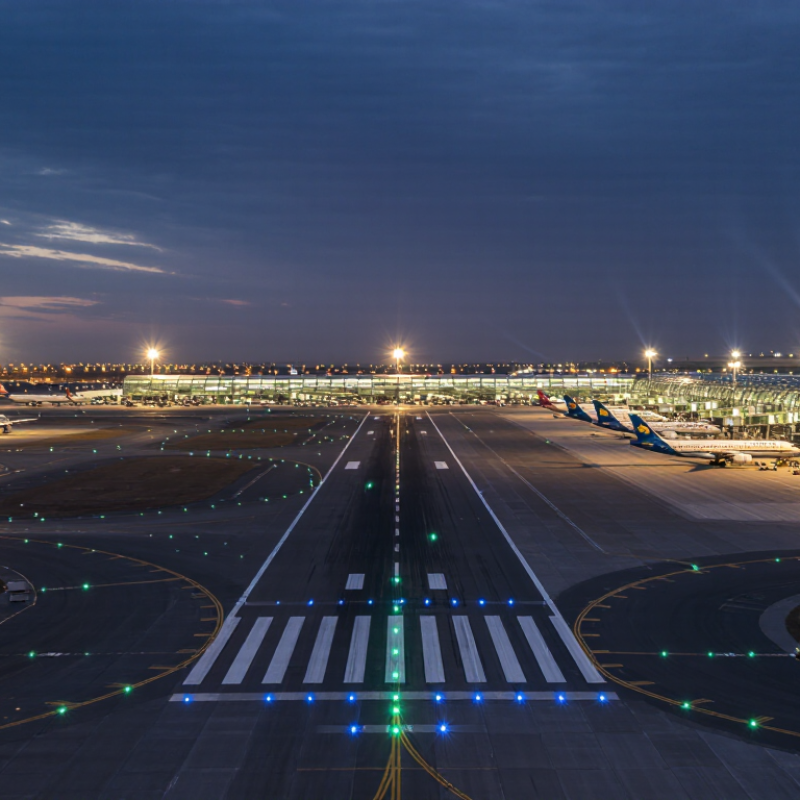
Airfield lighting must guide pilots through darkness, rain, fog, and confusing pavement layouts. The strongest systems combine runway edge lights, runway centerline lights, threshold lights, and runway end lights. Approach lighting extends that visual path before touchdown. Precision approach indicators help pilots judge their descent angle, while obstruction lights mark nearby towers, vehicles, and structures. These systems need accurate photometric testing, not just a bright appearance from the apron.
Taxiway lighting requires equal care. Blue taxiway edge lights define pavement boundaries, while green centerline lights guide aircraft through curves and holding areas. Red stop bars provide a clear instruction before runway entry. Apron floodlights improve ground visibility, but excessive glare can hide signals and reduce cockpit comfort. Programmable intensity settings are useful during changing weather. Independent circuits and backup power keep essential lights operating during electrical faults. Remote monitoring can report failed fixtures before a night inspection finds them.
In practical installations, drainage, snow, dust, and rubber deposits often cause more trouble than expected. Maintenance teams should inspect lenses, cable joints, mounting bases, and control panels on a defined schedule. Local aviation authorities and applicable international standards should guide layout and photometric limits. A design may look perfect on drawings yet perform poorly beside wet pavement. That is worth testing. Human error also remains possible, especially when markings, signs, and lights do not agree. Clear interfaces matter as much as powerful lamps.
10 Best Airport Infrastructure Lighting Solutions? - Airfield, Runway, and Taxiway Lighting Systems
| No. | Lighting Solution | Primary Airport Area | Typical Light Color | Common Installation | Typical Technical Characteristics | Main Operational Benefit | Recommended Use |
|---|---|---|---|---|---|---|---|
| 1 | LED Runway Edge Lighting | Runway edges | White; yellow on the final portion of some runways | Elevated fixtures installed along both runway sides | Omnidirectional or directional LED units; commonly spaced at regular intervals of up to approximately 60 m on precision runways, subject to the approved aerodrome layout; constant-current-series-circuit compatible | Defines runway limits and improves lateral guidance during takeoff and landing | All-weather runways, especially medium- and high-intensity operations |
| 2 | Runway Centerline Lighting | Runway centerline | White; alternating white and red near the runway end; red at the final section | Inset fixtures flush-mounted in the pavement | High-intensity bidirectional or unidirectional inset lights; typical longitudinal spacing is about 15 m on precision runways, depending on the approved design | Provides precise alignment and visual tracking in low visibility | Instrument approach runways and operations requiring enhanced centerline guidance |
| 3 | Runway Threshold and End Lighting | Runway threshold and runway end | Green toward the approach; red toward the runway end | Inset threshold bars and threshold-wing bar fixtures | Unidirectional or bidirectional lights arranged across the runway width; color direction changes according to the operating approach | Clearly identifies the usable landing threshold and the runway limit | Runways with displaced thresholds, instrument approaches, or night operations |
| 4 | Touchdown Zone Lighting | Initial touchdown area | White | Inset paired light bars positioned symmetrically about the runway centerline | High-intensity inset fixtures; commonly arranged in pairs over the touchdown zone, with layout determined by runway classification and approach requirements | Improves depth perception and touchdown-zone recognition in rain, fog, or darkness | Precision approach runways and airports with frequent low-visibility operations |
| 5 | Approach Lighting System | Approach path beyond the runway threshold | White, with red supplementary bars on certain precision approach systems | Elevated light bars, sequenced flashers, and alignment structures along the extended runway centerline | System length commonly ranges from approximately 420 m to 900 m, depending on approach category, terrain, and national requirements | Supplies visual alignment, roll guidance, and distance cues before threshold crossing | Precision and other instrument approach runways |
| 6 | Taxiway Edge Lighting | Taxiway edges, holding bays, and aircraft parking lanes | Blue | Low-profile elevated fixtures or inset fixtures near pavement edges | Omnidirectional blue LED units; spacing is typically regular and adjusted for curves, intersections, and taxiway width | Outlines taxiway pavement and supports safe aircraft movement at night | Airports with paved taxiways and regular nighttime aircraft operations |
| 7 | Taxiway Centerline Lighting | Taxiway centerlines, curves, and runway entrances | Green | Inset fixtures installed along the centerline or approved offset | Unidirectional or bidirectional green lights; spacing is reduced on curves and complex intersections to maintain continuous guidance | Provides continuous route guidance and reduces navigation errors on large pavements | High-capacity airports, complex taxiway networks, and low-visibility procedures |
| 8 | Stop Bar and Runway Guard Lighting | Runway holding positions and controlled taxiway intersections | Red stop bar; yellow runway guard position indicators | Inset light bars across the taxiway, combined with elevated or inset guard lights where required | Individually controllable fixtures with fail-monitoring capability; integrated with the airport lighting control system | Visually reinforces runway-entry restrictions and improves surface-movement control | Runway crossings, high-risk intersections, and low-visibility operations |
| 9 | Apron and Aircraft Stand Floodlighting | Aprons, gates, cargo stands, and maintenance areas | Neutral white | High-mast or pole-mounted LED floodlights positioned outside aircraft clearance areas | Typical maintained horizontal illuminance is approximately 20–50 lx for general apron tasks, with higher levels specified for detailed servicing; glare and uniformity require project-specific design | Supports ground handling, passenger boarding, fueling, cargo work, and inspection | Passenger terminals, cargo aprons, remote stands, and maintenance aprons |
| 10 | Obstacle and Aviation Warning Lighting | Towers, cranes, buildings, masts, and other fixed obstacles | Red steady or flashing; medium- and high-intensity white may be used where required | Mounted at obstacle tops and intermediate levels according to obstacle height and approved marking plan | Photocell or astronomical-timer control, fault monitoring, dual-light redundancy, and obstruction-specific flash patterns | Alerts pilots to structures that may affect approach, departure, or circuit operations | Airport boundary protection, temporary construction, communication towers, and tall buildings |
Note: Technical values are typical planning ranges. Final fixture photometry, spacing, colors, intensity settings, mounting heights, circuit design, and control logic must be verified against the applicable aerodrome certification requirements, approved lighting layout, runway classification, and local aviation regulations.
Terminal, Apron, and Landside Lighting Applications
10 Best Airport Infrastructure Lighting Solutions?
Terminal, Apron, and Landside Lighting Applications
Airport lighting must support safety, movement, comfort, and reliable operations. In terminals, energy-efficient LED fixtures provide clear illumination across check-in halls and security areas. Daylight-responsive dimming reduces energy use near glazed walls. High color rendering helps staff identify documents, baggage labels, and surface hazards. Emergency lighting maintains evacuation routes during power interruptions. Low-glare luminaires also protect passengers from harsh reflections on polished floors and glass.
Apron areas need stronger and more carefully aimed systems. High-mast floodlights illuminate aircraft stands, service roads, and loading zones. Adjustable beam optics reduce glare for pilots and ground crews. Aircraft stand guidance lights define parking positions without creating visual confusion. Weather-resistant housings withstand rain, dust, vibration, and temperature changes. Redundant power supplies can keep essential apron lighting active during faults. Small details matter here.
Landside applications require a different balance. Roadway lighting supports smooth vehicle circulation around terminals. Parking-area fixtures improve visibility between cars and pedestrian routes. Covered walkways need even light, not bright spots beside dark gaps. Smart controls can adjust output using schedules, occupancy data, and ambient light sensors. Maintenance teams should track failures, lux levels, and glare complaints through regular inspections. I have seen well-lit projects lose performance because cleaning schedules were ignored. No design is perfect. Human feedback still matters.
10 Best Airport Infrastructure Lighting Solutions
Typical maintained illuminance targets for terminal, apron, and landside applications
Interior terminal areas generally require higher illuminance for passenger movement, document checks, retail activity, and baggage handling. Apron floodlighting uses lower horizontal illuminance while prioritizing glare control, uniformity, aircraft visibility, and safe vehicle operations. Curbside, parking, and roadway values vary according to traffic speed, pedestrian activity, and local road-lighting regulations. These are typical planning values; final designs should comply with the applicable airport authority, ICAO, CIE, EN 12464-1, and local standards.
Energy Efficiency, Smart Controls, and Maintenance Considerations
10 Best Airport Infrastructure Lighting Solutions?
Airport lighting must balance energy efficiency with safety, visibility, and continuous operation. The U.S. Department of Energy reports that LED systems can use at least 75% less energy than incandescent lighting and last up to 25 times longer. That benchmark is useful, although airport conditions are harsher. High ceilings, vibration, dust, and long operating hours can reduce real-world performance. Select sealed fixtures with suitable ingress protection, stable color output, and emergency compatibility. A bright terminal is not automatically an efficient terminal.
The U.S. Department of Energy reports that LED systems can use at least 75% less energy than incandescent lighting and last up to 25 times longer.
Smart controls can reduce waste in concourses, parking areas, service corridors, and perimeter roads. Daylight dimming, occupancy sensing, and scheduling should respond to passenger flow. The International Energy Agency’s Energy Efficiency 2024 report continues to identify efficient lighting as a practical energy-saving measure. However, controls must never compromise evacuation routes or airfield visibility. A failed sensor can create an unsafe dark zone. Manual override remains essential. This detail is often underestimated.
Tips: Measure light levels before replacing fixtures. Record operating hours, failures, glare complaints, and cleaning costs. Use a pilot zone before a full airport rollout. Track kilowatt-hours and maintenance calls monthly. Do not judge savings from wattage alone. Commissioning errors can quietly erase expected benefits. Schedule inspections around low-traffic periods, and keep compatible spare components onsite. Maintenance teams should review control settings after seasonal daylight changes.
FAQS
It illuminates aircraft stands, service roads, loading zones, and nearby ground equipment. Clear views support safer work during darkness and poor weather. Small details matter.
Runway edge lights define safe movement paths in darkness or low visibility. Taxiway centerline lights guide aircraft through turns and complex junctions. Alignment matters.
Approach lighting helps pilots judge runway alignment before landing. It provides visual reference during nighttime operations and difficult weather. It cannot solve every visibility problem.
Even lighting supports check-in, security, and wayfinding areas. Low-glare fixtures reduce harsh reflections on glass and polished floors. Bright spots alone are not enough.
Controls can dim empty corridors and respond to daylight near windows. Occupancy data and schedules can adjust output in landside areas. Sensors sometimes misread fog or reflections.
Emergency lighting should keep evacuation routes visible during outages. Backup power helps maintain essential illumination when normal systems fail. Testing is still necessary.
Baggage-area lighting should reveal labels, moving belts, and possible obstacles clearly. Good color rendering helps staff identify details quickly. Poor aiming causes confusion.
Teams should inspect fixtures, measure illumination, review energy use, and record repairs. Cleaning schedules matter because dust can reduce performance. Human inspections still matter.
A trial on one apron or corridor can reveal weak assumptions early. Staff feedback may expose glare, shadows, or maintenance problems. No design is perfect.
Conclusion
Airport Infrastructure Lighting plays a critical role in ensuring safe, efficient, and reliable airport operations from airfield movement areas to passenger facilities. This article reviews the main lighting requirements and evaluation criteria, including visibility, uniformity, durability, weather resistance, glare control, regulatory alignment, and ease of maintenance. It also presents ten leading solution categories designed for different operational needs, such as runway edge and centerline lighting, taxiway guidance systems, apron floodlighting, terminal illumination, parking areas, roadways, and other landside applications.
The discussion also highlights how modern LED technology, intelligent controls, sensors, and centralized monitoring can improve energy efficiency while supporting safer airport management. Practical considerations such as installation conditions, maintenance access, equipment lifespan, emergency readiness, and lifecycle costs are examined to help decision-makers select suitable systems. By balancing performance, reliability, sustainability, and operational flexibility, airports can create a well-coordinated lighting environment that supports aircraft movement, ground handling, passenger comfort, and long-term infrastructure development.

Blog Tags: